How utilities do (or don’t) innovation

In the spring and summer of 2017, we spoke to the innovation leads of over 20 utilities.  There’s good reason that utilities aren’t well known for innovation, but there’s still much to learn about how they do innovation.

What We Did:

  • Spoke to the innovation leads at 21 utilities.  Sometimes innovation leads were in R&D, some in strategy or strategic planning, others still in business development
  • Asked them a standard list of questions related to innovation.  This list is a bit too long to list here in entirety, but topics included:
    • Strategy – What do you hope to achieve with innovation and why?
    • Structure & Process – How do you manage, measure, and govern innovation?
    • Execution – How do you prioritize and structure your innovation activities?

what-we-did-specifically.jpg

What We Learned:

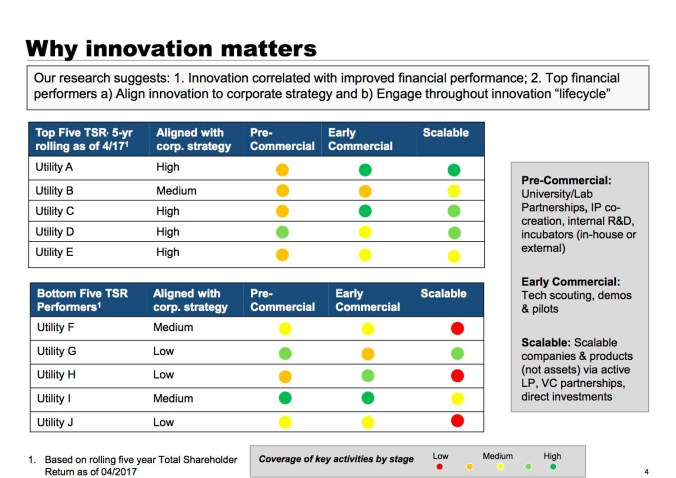
  1. Innovation correlated with improved shareholder performance
    stoplight-chart-e1521406192714.jpg

    Those utilities we interviewed who aligned their innovation strategy, dollars and activities in a way that helped them execute their corporate strategy, had superior shareholder performance.

  2. Top performers focus.  In other words, they DON’T do everything equally well.  While they tend to have “bets” across the innovation spectrum (from early R&D stuff through to more mature investments) they focused on certain stages or areas unequally.  In other words, specific areas or activities that were aligned to corporate strategy drew an outsized portion of time, attention, and dollars.
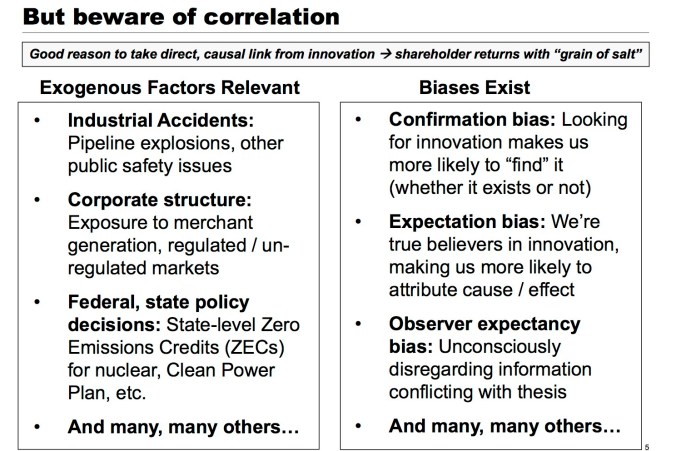
  3. Correlation does not imply causation:

    Correlation Causation

    Don’t forget that famous dictum.  There’s all sorts of good reasons to avoid drawing a direct, casual link from innovation to improved financial performance.  All sorts of exogenous factors affect financial performance – from pipelines unexpectedly exploding, to other accidents or natural disasters that have nothing to do with innovation – so take the correlation with a big “grain of salt”

  4. But innovation capability helps strategy execution: Whether or not you can draw a direct line from financial performance to a utility’s ability to innovate, our work indicates that utilities better able to innovate – and tie innovation activities to execution of a corporate strategy – are in a better position, financially or otherwise.
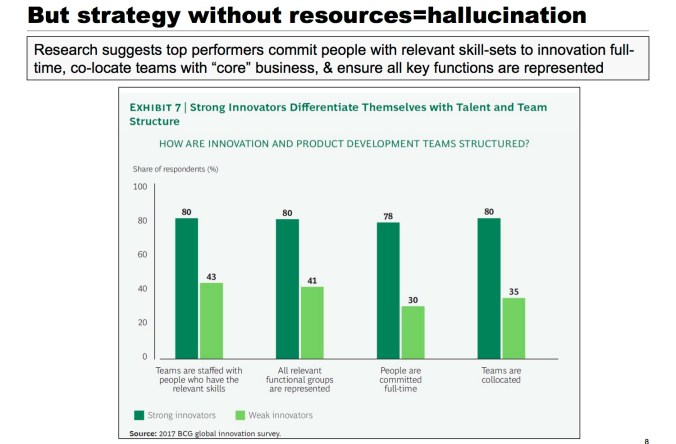
  5.  Dedicate people full-time, in the same place, ensure they have the right skills and represent the right functions:
    BCG Slide

    All credit to the consulting firm Boston Consulting Group (BCG) for this finding.  They looked at top innovators across industries and found that teams are staffed with people who have skills relevant to innovation-related positions, that all relevant functional groups are represented in innovation teams, that these teams are located with the “core” business, and that they are staffed full time

The Case for Process: A Structure That Follows Strategy

How do we tell whether a process is well designed and constructive?  First it’s to remember that process isn’t valuable as an end or a goal in and of itself.  Instead, process is a servant and strategy is the master.  Said differently: process should represent the structure that follows from the strategy in question.

Let’s make this a bit less abstract and a bit more tangible.  The first and most obvious place where things go awry is when fills the vacuum left in the absence of strategy.  The worst processes are found supporting activities where the objectives are never enunciated, unclear, or whether the principles involved in a process have conflicting understandings of the objective in question.

Good Process Starts with Strategy

The first step, therefore, to creating a good process should start with the strategy.  Everyone meaningfully involved in a process should be able to answer, in the same way, the question: “Why are we doing this?  What are we hoping to achieve by engaging in this process?”  Often, a process is streamlined and simplified radically simply by forcing the owners of the process to enunciate their objectives.  Often, making objectives explicit surfaces long-standing differences that necessitate discussion and resolution.

After identifying the objectives, the value of process should be measured by the degree to which it furthers the strategy in question.  Indeed, process is the structure that follows naturally from the strategy at hand.  Strategy, in other words, is the means by which we determine whether a process is effective.  Diverse strategies, therefore, can yield diverse and creative processes.

Examples of structure following strategy

For instance, is your strategy to try to get to market as quickly as possible?  This is likely to yield a minimalist process that likely involves fewer steps to approval and less QA.  Is your strategy to identify the top 3 or so issues that a business unit at a large company should be focused on?  This would require a much more participatory, and probably slower, process that might even involve research outside a company’s walls. It will also likely require multiple iterations on a proposed set of priorities before finalizing (because some level of agreement is necessary for such a strategy to stick).

How do you know if it’s working?

Beyond a constant reference to the objectives at hand, how do you know whether a process is successful or not?  Before even launching the process, leaders should define how they will measure the success of the initiative.  If the goal is speed to launch, there should be metrics around speed/progress every step of the way.  If the objective is improved customer and/or stakeholder satisfaction, that should be measured every step of the way through surveys (external and internal) including questions that drill down on each key component of the process in question.

These measures, in turn, should be used to constantly refine and improve the process in question.

The Case Against Process

In high tech and startup circles recently, process has become a dirty world.  Conventional wisdom has it that process is an unnecessary impediment to the famous Facebook motto of: “move fast and break things.”  It prevents experimentation, slows progress, adds bureaucracy, and makes the famous lean startup motto of “launch and iterate” much more difficult.

Complaints against process, particularly recently, can be summarized as: process slows things down, and is therefore bad.  One hears this complaint quite frequently in startup world where each hour represents a finite supply of cash and a day closer to business death.  Even larger companies have embraced agile methodologies, and are spending massive funds trying to be more nimble and fostering startup culture in their walls.

So does process make things slower?  If designed poorly, unequivocally yes.  Surely those who have worked in large companies or in government can sympathize with decision-making structures involving committees who are ill-informed about the decision in question, or procurement mechanisms that slow decisions while adding little value.

Yet good process often makes things move faster.  Indeed, even the lean mantra of “launch and iterate” works better (and faster) with well-designed process.  For instance, when considering a technical or product change, in the form of an A/B test, you have to know what you are measuring.  Simply launching such a test without clearly defining your hypothesis beforehand – what you are hoping to learn from the test – means such a test may not measure the right things.  So a team burns time and money and effort experimenting, but learns little from that experiment.  Much better to spend the time up-front discussing what the hypothesis of the experiment is, thinking about what the team wants to measure, ensuring that those metrics are part of the test, and then ensuring that the test results in learning/progress towards a Minimum Viable Product (MVP).

In short, much of the case against process is right but is fundamentally only an objection to poorly-designed processes.  Our next blog will give examples of how well-designed processes can enable organizational speed and execution, not act as an impediment to it.